
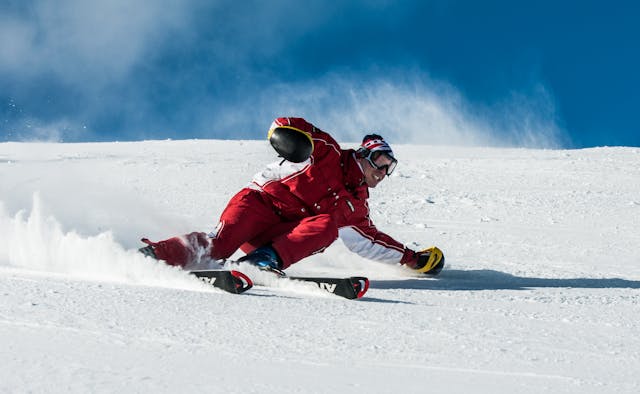
Carving means making turns on the edges of your skis with little or no sideways slip. The shape of the skis and the way they flex help form the turn. Simply keeping your skis parallel or leaning far into the turn is not enough.
Two narrow, curved tracks in the snow help illustrate a carved turn. Keep control of your line and speed, and leave enough room for other people.
Carving, parallel skiing and skidding
| Term | What it describes | What it does not establish |
|---|---|---|
| Parallel | The position of the skis relative to each other | Whether the skis are turning without skidding |
| Carving | Turning on the edges with little sideways slip | Whether a particular slope is suitable |
| Skidding | Sideways movement relative to the direction the ski is pointing | Whether the skier made a technical error |
The PSIA-AASI explanation of slalom turns distinguishes carving from sideways slip and describes the curved tracks a carved turn leaves. Use it to understand how the skis move, without trying to match race speeds.
How ski design affects the turn
The tip, waist and tail help define the ski’s sidecut. That shape, along with the ski’s length, stiffness, profile and flex during the turn, affects how it responds.
Buying skis labelled as carving skis will not make every turn a carved one. You can improve without choosing the most performance-oriented model. The Salomon guide to piste skis explains how ski features suit different ability levels and uses.
Why skidding can be useful
Your technique should suit the route and conditions. A controlled skid can help you manage your line and speed. Trying to eliminate all sideways slip is impractical when you lack space or control.
Parallel describes the position of your skis relative to each other. A parallel turn can involve more or less skidding as the skis move across the snow.
What to practise before trying to lean further
- Balance you can adjust throughout the turn.
- Control of pressure and edge angle.
- A line that leaves room for other people.
- The ability to change technique when conditions call for it.
These skills work together. Copying a position from a photo or putting more force through your knees will not develop them. An instructor should watch you ski and choose exercises on suitable terrain.
How to approach it in a lesson in Baqueira
When you enquire about ski technique lessons, explain whether you already link turns with control and what you want to understand about edging or pressure. You can work on a specific part of the movement without expecting to carve by the end of the lesson.
If you want more time to observe, practise and review, see our private days with an instructor. A longer lesson still calls for gradual progression and suitable terrain.
Progress means having more techniques available and knowing when to use them. Carving is one of those techniques.
Frequently asked questions
Does turning with parallel skis mean you are carving?
No. Parallel describes the position of the skis relative to each other. Carving describes turning with little sideways slip.
Is skidding always a mistake?
No. A controlled skid can help you manage your line and speed. Its usefulness depends on the task and conditions.
Will carving skis make me learn automatically?
No. Equipment affects how the skis respond. You still need technique, instruction and practice suited to your ability.
Should I ski faster to learn carving?
Avoid chasing a target speed. Work with your instructor on suitable terrain, stay in control and leave room for others.