
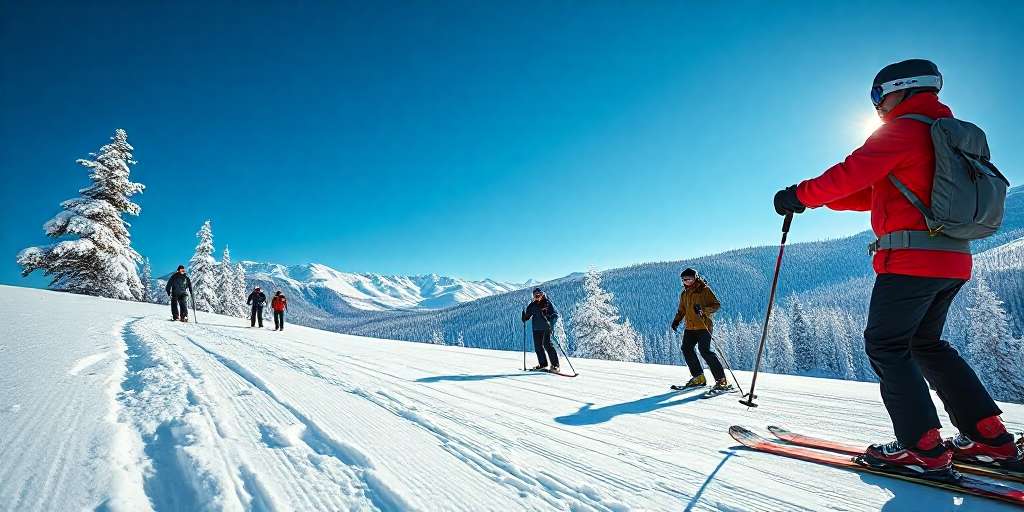
Ski movements include turning, skidding, edging, flexion and extension. You will also hear terms such as wedge, parallel and schuss. Some describe actions, others describe the position of your skis or the way you travel down a slope.
If your instructor asks you to put weight on the outside ski and you are unsure which one that is, the difficulty may simply be vocabulary. This glossary helps you ask more precise questions. Understanding a term alone does not prepare you to try the manoeuvre on your own.
Terms you will hear on the slopes
| Term | Meaning |
|---|---|
| Turn | A change of direction |
| Wedge or snowplough | The ski tips are close together and the tails are apart |
| Parallel | The skis point in parallel and can remain apart |
| Skidding | The skis slide partly sideways across the snow |
| Edging | Changing the angle of the skis relative to the snow |
| Flexion and extension | Bending and straightening joints to adapt to the situation |
| Pole plant | Touching the pole to the snow to help time certain turns |
| Schuss | Skiing straight downhill without linking turns |
How turning, skidding and carving fit together
A turn is any change of direction. In a turn, you can steer the skis and let them slide sideways or let their edges guide them along a cleaner track. You can skid deliberately to manage your line and speed.
Carving aims for turns with very little sideways slip. Other types of turns can be the right choice depending on the run. If you want to work on these differences on snow, try a private technique lesson.
Inside and outside skis
The outside ski is on the outside of the turn. The inside ski is on the side you are turning towards. They switch when you change direction. When your instructor asks you to weight the outside ski, you can keep the other ski on the snow.
Terms for stages of learning
Wedge turns, turns that begin by opening the skis into a wedge, and first parallel turns are terms you may hear as you progress. The terminology varies between teaching methods. If you hear “basic parallel” or “advanced parallel”, ask your instructor to describe the exercise you will actually do.
Before you start, focus on what movement you are trying, what it does and where it is appropriate to practise it.
Terms that describe techniques and formats
A schuss is a direct descent. Keep to a line that lets you control your speed and respect other slope users. Avoid trying it in narrow passages or treating it as a speed challenge.
Wedeln usually refers to linked short turns. Stem Christiania is a traditional term for a turn that begins by opening the skis into a wedge. An instructor can choose a progression that suits your ability.
Halfpipe and slopestyle are disciplines or competition formats. You will hear different terms for the basic movements in a first lesson.
How to use the glossary in a lesson
If an instruction is unclear, ask for a demonstration and repeat it in your own words. “Do you want me to turn my legs or change the angle of the ski?” Ask before descending so you can focus on skiing.
With young children, instructors adapt their explanations so the child can understand the task without memorising technical terms. See children’s lessons in Baqueira for instruction suited to their experience. Adults can refer to the PSIA-AASI fundamentals, which distinguish balance, pressure, steering and edge control.
Frequently asked questions
What are ski turns called?
Turn is the general term. You can also describe a turn by the position of the skis, the line they follow and how much they run on their edges or skid.
What does edging mean?
It means changing the angle of the skis relative to the snow to use their edges. How and how much you tip them depends on the situation.
Is the outside ski always on the same foot?
No. The outside ski is the ski on the outside of a turn and changes when you turn the other way.
Does schuss mean skiing as fast as possible?
No. It means skiing straight downhill. Stay in control of your speed and choose a suitable line.