
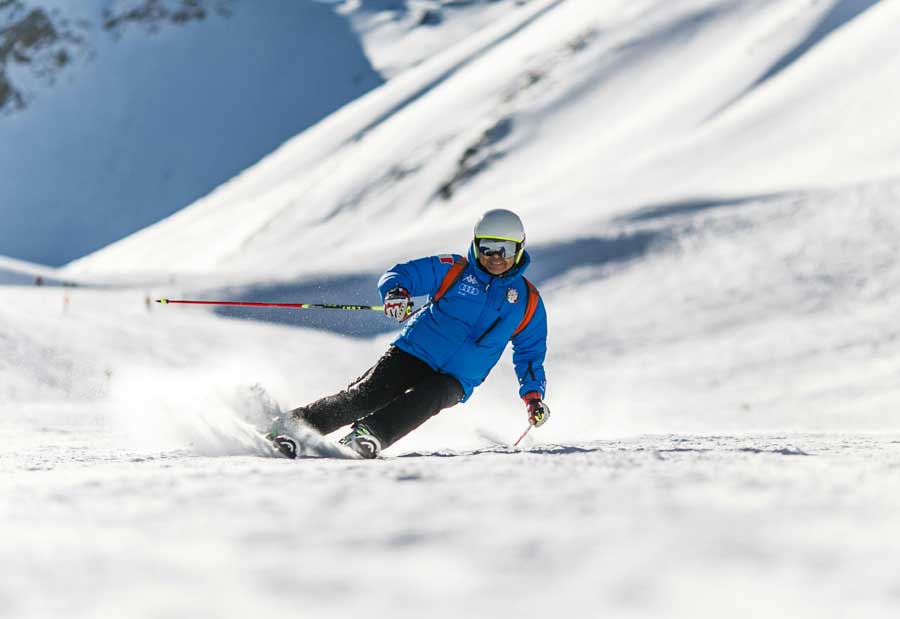
You can describe ski turns by the position of the skis, as in snowplough and parallel turns, and by how they travel across the snow, as in skidded and carved turns. A parallel turn can also be skidded.
Two questions clarify the terminology
How are the skis positioned relative to each other? How do they trace the curve on the snow? Answering both questions helps you tell whether a parallel turn is carved.
| Term | Main idea |
|---|---|
| Snowplough | Tips close together and tails apart |
| Parallel | Skis pointing in parallel directions |
| Skidded | The skis slip sideways |
| Carved | The skis travel on their edges with little sideways slip |
The snowplough helps you learn to turn
The snowplough can help you practise direction and speed on suitable terrain. Our guide to making a snowplough explains how to start. If you need a very wide snowplough to get down a run, choose easier terrain.
In children’s ski lessons, instructors adapt explanations and exercises to the child’s experience. Make the move to new terrain based on what the child can do on skis.
Parallel skis allow different kinds of turns
As you learn parallel turns, coordinate your movements so you can turn without opening into a snowplough each time. Leave room between your feet. You can then refine pressure and transitions, using a carved turn where it suits the situation.
In a private ski technique lesson, you can work on what you need, whether that’s starting, finishing or linking turns. Choose the exercise based on what the instructor sees on snow.
You can use a skid to stay in control
You can skid deliberately to control your line and speed. An unexpected slip can take that control away. Explain to your instructor which you’re experiencing.
Carve when the terrain, space and your speed allow it. Keep enough room to stay in control as you practise. See our guide to carving for more detail.
What about short and long turns?
They describe the shape and rhythm of your line. Choose a turn radius that suits the piste and the people around you. If you want time to practise and apply feedback, consider a day with an instructor that suits your fitness.
The PSIA-AASI skiing fundamentals explain how balance, pressure, steering and edge control work together. Adapt your stance to the turn and conditions.
Frequently asked questions
Can a parallel turn be skidded?
Yes. Parallel describes the position of the skis. Skidded describes how they move across the snow.
Is carving the best technique in every situation?
Choose a turn that suits the terrain, available space, conditions and your level of control.
Do I need to learn all the turns in a fixed order?
Progress depends on your skills and needs. Choose the next exercise based on what you need to learn.
Is bringing my feet together enough to ski parallel?
No. Coordinate steering, balance and pressure, and leave room between your feet.