
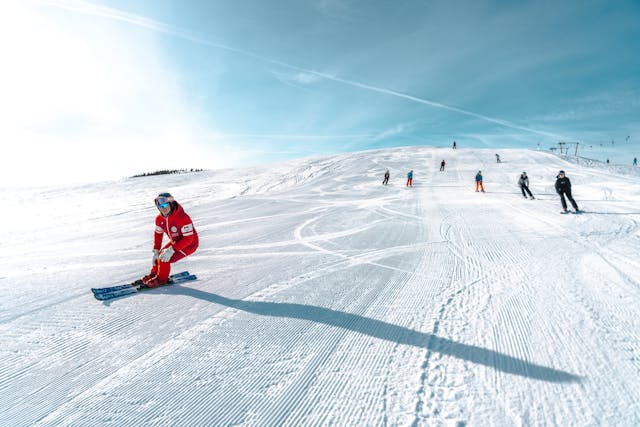
If your ski stance makes you tense or uncomfortable, notice when it happens and whether the exercise and equipment suit you. Let your stance change as you ski down the run.
A photo can illustrate an idea, but skiing happens in motion. What you need to do can change as you start, finish or link turns.
Describe the discomfort before trying to correct it
| Question | What it helps you check |
|---|---|
| When does it happen? | At the start, during the turn, in transition or at the end |
| Does it happen on both sides? | Differences between turns |
| Does it happen only on that piste? | The effect of difficulty and conditions |
| Do your boots hurt? | Whether your equipment needs checking |
| Does it get worse with each run? | Whether fatigue or breaks play a role |
Share what you’ve noticed in a private ski technique lesson. Your instructor can assess the exercise. Seek healthcare advice for pain or a health issue.
Check what’s behind the stance before leaning forward
Sitting too far back can make movement harder. Pushing your upper body forward without understanding what’s happening can introduce another compensation. Let your ankles, legs and pressure on the skis adjust. Keep your joints free to move instead of trying to match an outline.
The guide to balance and pressure on your skis explains how these work together. Pick a change you can observe and check how it affects your skiing.
Check your equipment too
Tell your equipment provider where you feel pain or pressure, or if your foot moves inside the boot. Have the size and fit checked before tightening the boots further. Leave binding adjustments to a qualified technician and address stance concerns separately.
If you have time to practise with breaks, consider a day with an instructor. Use the time to work on what you need and adapt your stance as you move.
Choose easier terrain so you can observe your movements
On terrain you struggle with, simply trying to get down can make you tense. Easier terrain gives you time to focus on one task and notice what changes.
Stop if you feel pain or discomfort. Seek advice if it persists.
Frequently asked questions
Is there a perfect stance for the whole run?
No. Balance and movement adapt to each moment and situation.
Should I always lean farther forward?
First understand how you move and apply pressure to the skis. That helps you choose an appropriate correction.
Do I have to put up with pain to improve?
No. Stop skiing and consider what’s causing the pain and whether you need care.