
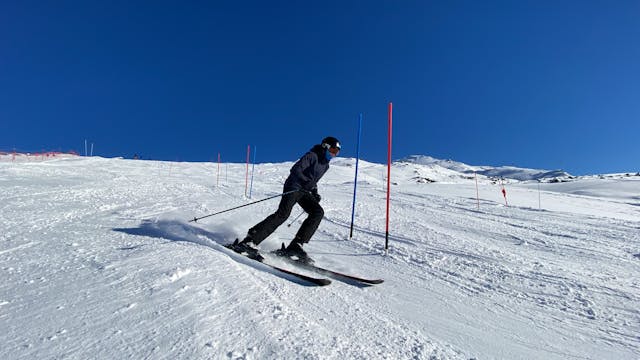
To practise short turns, coordinate changes of direction and pressure on your skis while keeping to a speed you choose. Avoid forcing your knees to turn or entering a slope faster to make the turn happen.
A smaller turn radius gives you a specific technique to practise. Choose a line that suits the space, snow and control you have on the day.
Start by deciding what you want to change
| Term | What it describes |
|---|---|
| Short turn | The size and rhythm of your turns |
| Narrow piste | The space available to ski through |
| Tight bend in a piste | The shape of a section of the piste |
See our guide to bends and junctions on pistes for advice on choosing a line around other skiers. Here the focus is on practising short turns.
What happens when you try to tighten a turn?
Describe whether you pick up speed, freeze between turns or find that one ski moves away from the other. During a private ski technique lesson, the instructor can watch what happens and choose suitable terrain and an exercise. What you feel is one clue to the cause.
Let your weight distribution and the distance between your feet adapt from turn to turn. The movements and pressure you need depend on the situation.
Find a rhythm you can sustain
If you link turns faster than you can manage, you may find yourself braking hard repeatedly. Simplify the exercise and pay attention to how you finish one turn and start the next. A gentler slope gives you room to observe both.
The PSIA-AASI alpine skiing criteria relate balance, pressure, steering and edge control. Work on how these movements fit together before focusing on a single cue about your knees.
A few turns can be enough to see what’s happening
- Agree on a goal with your instructor.
- Practise on suitable terrain and leave room for others.
- Stop before fatigue changes how you perform the exercise.
- Discuss what you could repeat and what you struggled to repeat.
If you want more time to apply corrections, consider a day with an instructor. Adapt the duration and exercises to what you can manage.
What to expect from your equipment
A ski’s stated turn radius gives you information about the ski. The turns you can make still depend on your technique and conditions. Ask your equipment provider if you’re unsure about your skis or how they respond. Leave binding settings alone when working on tighter turns.
Frequently asked questions
Do short turns mean skiing fast?
No. Turn size and speed are separate aspects of skiing.
Should I force my knees inward?
Avoid forcing your knees. Short turns require coordination and an assessment of how you move.
Will skis with a short turn radius guarantee I can make short turns?
No. Choose suitable terrain and work on technique even when using skis with a short radius.