
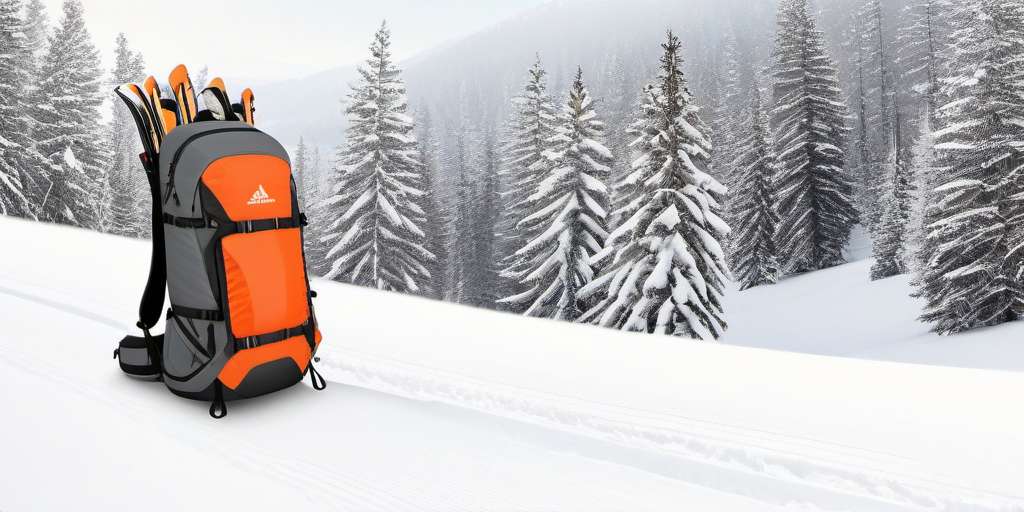
To carry skis on a backpack, use a pack designed for ski carry and follow the manufacturer’s instructions for its attachment points. A-frame and diagonal carry are common, but some packs support only one of them. Securing the skis frees your hands while walking. The total weight stays the same.
First decide whether you need to carry skis this way. A mountain route with sections on foot has different requirements from walking from a rental shop to a lesson meeting point. For an ordinary morning at the resort, a touring pack may be unnecessary.
A-frame and diagonal carry
| System | How the skis are arranged | What to check |
|---|---|---|
| A-frame | One ski on each side, secured using the manufacturer’s system | The pack’s loops, straps and upper stabilisation |
| Diagonal | The skis run diagonally across the outside of the pack | Dedicated lower and upper attachment points |
| Pack without ski carry | There is no confirmed ski carry system | Avoid using shoulder straps or zips as improvised attachment points |
The specifications for an Osprey technical backpack list both carry systems. This is an example of a pack designed for the purpose. Check your own model for its attachment points.
Find the attachment points that bear the load
Consult the manual to identify the reinforced loops and straps designed for the skis. A clothing bungee, helmet clip or zip pull serves a different purpose.
Check seams, buckles and straps before attaching the skis. If anything is damaged or you are unsure what a part does, check before using it. Follow the instructions for your own model.
Check the setup before you start walking
- Attach the skis somewhere with enough room to handle them.
- Secure the load first, according to the manufacturer’s instructions, then adjust the backpack to fit you.
- Check that the skis cannot shift unexpectedly or interfere with your movement.
- Consider where the tips, tails and edges sit relative to your body, other people and obstacles.
If the setup is unstable, check the positioning and compatibility before you proceed. Extra knots will not resolve an unsuitable setup. When removing the skis, find enough space and keep the skis under control so they do not hit anyone nearby.
Check whether the route is suitable
Carrying skis on a pack does not establish that you are prepared for a mountain route. Assess the route, weather, snow and hazards separately. Avoid following tracks off-piste simply because you have equipment that lets you carry your skis.
When using lifts, follow staff instructions for backpacks and equipment. Check whether you need to remove the skis from the pack before boarding.
If you are taking a lesson or walking on snow
For ski lessons on the slopes in Baqueira, confirm where to meet and how to get there with your equipment. Ask if you need to bring anything else. An oversized pack can complicate a simple trip to the meeting point.
If you want to walk on snow without skiing, look into a snowshoe outing and check what equipment you need. The outing has its own route and preparation requirements.
Frequently asked questions
Can I attach skis to any backpack?
Use only a ski carry system designed for the purpose and compatible with your equipment. Follow the manufacturer’s instructions and avoid improvised load points.
Does carrying skis on my back reduce the weight?
The total weight stays the same. Carrying skis on your back changes where you bear the load and can free your hands while walking.
Is diagonal carry always better than A-frame carry?
No. It depends on the pack, equipment and activity. Check which systems your pack supports.
Can I board a ski lift while wearing a backpack with skis attached?
Check first. Follow the lift staff’s instructions for handling your skis and backpack.